Evaluating decals usually focuses on graphics, colors, and finish. But the real performance driver is something you can't see–adhesive.
A decal is only as good as its ability to stay attached
The right adhesive helps graphics withstand years of UV exposure, rain, temperature changes, vibration, pressure washing, chemicals, and everyday wear. Adhesive selection can be the difference between a decal that performs for 7+ years and one that peels at the edges within months.
At Romo Durable Graphics, we know that durability starts long before the decal is installed. It starts with matching the right adhesive to the surface.
Think of Adhesive as Microscopic Velcro
Most surfaces look smooth to the naked eye. Under a microscope, however, they resemble a landscape filled with tiny peaks, valleys, and imperfections.
For an adhesive to create a strong bond, it must:
Flow into those microscopic valleys
Make complete contact with the surface
Create a molecular attraction to the material
This process is known as wet-out. The better an adhesive can wet out across a surface, the stronger and more durable the bond becomes.
Surface Energy: The Factor You Can't See
One of the most important factors affecting decal performance is surface energy. What is Surface Energy? A Simple Way to understand it, visualize what happens when water lands on a surface.
High Surface Energy Surface – Water spreads out and covers the surface
Low Surface Energy Surface – Water beads up and stays concentrated
Adhesives behave much the same way.
If an adhesive can't spread across a surface, it can't achieve proper wet-out. And without proper wet-out, even the highest-quality graphic can struggle to stay in place over time.
High Surface Energy Materials is Easy
These materials allow adhesives to spread and bond more easily:
Painted steel
Stainless steel
Aluminum
Glass
Low Surface Energy Materials is Challenging
These surfaces often require specialized adhesives:
Polypropylene/Polyethylene (PP/PE)
Powder-coated surfaces
Plastics containing mold release agents
That's why selecting a decal isn't just about the artwork. It's about understanding the environment, the substrate, and the adhesive system working behind the scenes. At Romo, we engineer decals to perform in real-world conditions, ensuring the bond is just as durable as the graphic itself.
Why Thicker Adhesives Often Perform Better on Textured Surfaces
Manufacturing equipment features textured powder coats, molded plastics, or other irregular surfaces. While these finishes may improve appearance or durability, they also create challenges for adhesives. The reason is simple: the adhesive must bridge a landscape of peaks and valleys.
A standard adhesive may only contact the high points of the texture, leaving gaps underneath. A thicker adhesive layer can flow deeper into those valleys, increasing surface contact and creating a stronger overall bond. But, adhesive chemistry still needs to be matched to the specific substrate and operating environment.
At Romo, we evaluate both thickness and adhesive formulation to fit the application.
Pressure Matters More Than Most People Realize
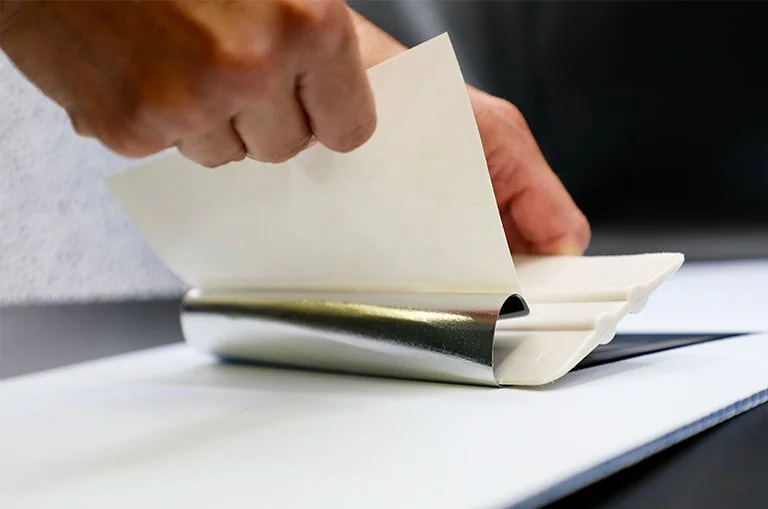
Pressure-sensitive adhesives (PSAs) earn their name for a reason: they require pressure to perform properly. One of the most common causes of decal failure isn't the material itself. It's inadequate installation pressure.
Proper Application
Firm squeegee pressure
Roller application when appropriate
Full adhesive wet-out across the substrate
The more complete the initial contact, the stronger the bond will become over time.
Temperature During Application Is Critical
Most adhesives perform best when applied between 60°F and 100°F (16°C to 38°C) and become less flexible when temperatures drop.
The Four Most Common Causes of Decal Failure
1. Substrate incompatibility - not analyzing the surface energy
2. Surface Contamination
Oil
Mold-release agents
Dirt and dust
Cleaning chemical residues
Even fingerprints can reduce adhesion and create failure points.
3. Insufficient Application Pressure
Without enough application pressure the adhesive never fully wet, affecting bond strength.
4. Environmental Exposure
Outdoor equipment creates some of the toughest conditions for durable graphics.
UV radiation
Extreme temperatures
Moisture
Chemicals
Abrasion
Pressure washing
Only properly engineered adhesive systems are designed to withstand these challenges.
How Romo Validates Adhesive Performance
At Romo, we don't rely solely on product data sheets. We believe durable graphics should be validated with real-world testing before production begins. Depending on the application, testing may include:
Peel adhesion testing
Shear testing
Surface energy analysis
Xenon weathering, thermal & environmental aging
Chemical resistance testing
This helps identify the best-performing construction for the specific substrate and environment – reducing field failures, warranty claims, and replacement costs.
A durable decal is far more than ink printed on vinyl or polyester.
When adhesive selection matches the substrate, application process, and operating environment, decals can perform reliably for 5, 7, or even 10+ years outdoors. The most expensive decal isn't the one that costs a few cents more. It's the one that fails in the field and has to be replaced.
Investing in the right adhesive selection, testing, and validation upfront is one of the highest-return decisions an OEM can make.